
Rôle Public
Colloquium
April 22, 2012
The landscape we share. Sensibilities and landscape mobilisations in the urban project.
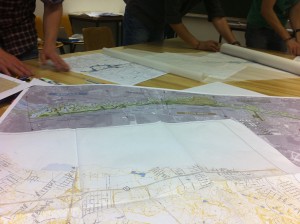
The death of landscape has been heralded some time ago; and yet, for at least the past ten years, we have witnessed its significant return in planning practice. Indeed, there is a consensus aiming to turn landscape into a pertinent object of the urban project; landscape is a crucial element both in that it can guarantee the coherence of a project, framing it within the larger planning scale (green infrastructure, blue infrastructure…) and in that it mediates between distinct urban institutions or structures (nature, organisation, technical networks, etc.).
In fact, this interest in landscape comes from its relatively unfocused nature. In terms of planning, the logic of landscape is determined by what sociology of sciences and techniques has labelled “boundary-objects”: these are objects with vague borders allowing a confluence of different social spheres. Landscape is a space where interdisciplinary knowledge, heterogeneous rationalities and various interests meet and sometimes clash when trying to define the place of intervention and thus a consequent spatial response.
In more unusual cases, landscape can be mobilised as a last resort to create coherence a posteriori, what we call a naturalisation process: the site has untouchable features and it would have been suitable to convert it following these features.
Thus, landscape is at the same time a method of analysis, a tool of mediation and a mode of argumentation.
To “landscape” and “make the landscape” also means enrolling resources (water, time, culture, identities) to foster a spatial response. Hence, the unfocused nature of landscape becomes an advantage, marking landscape as analogous of public space: a space which organizes the encounter between elements distant in time and space to create a social unity.
It is precisely the efficiency of the indecisiveness of landscape that this colloquium would like to address. With this aim in mind, we will follow three threads:
The first thread targets the ‘sensibilities’ of landscape; indeed, landscape is a space where interventions on the living environment become perceptible, because they are visible. That is what we intend by ‘sensibilities’, or, in other words, a sense for landscape. The ‘sensible’ landscape is a place where “what changes” manifests itself; a place where an apperception happens; a place of mobilisation – in the sense of rallying for a cause. We will consider conflicts of uses and rationalities that emerged along landscape projects. We will also try to understand to what extent the different actors of landscape controversies affect landscape. For instance, is landscape mobilised in such discourses because it participates to what makes the beautiful, the right, the adequate? In the long run, collective mobilisations following these initial ‘sensibilities’ can be analysed. We will thus also consider the issue of the identity of landscapes in planning. The issue of landscape sensibilities also has to consider a patrimonial issue, that of the roots to valorise in landscape projects – the “untouchable” features from which landscape can emerge.
The second thread will deal with the capacity of landscape to function as a meeting point of heterogeneous fields of knowledge and interests. These are different if not even divergent. Communication proposals gathered in this section will pay close attention to the identification of participation tools in landscape projects — this from a reflexive and critical point of view. We will also consider the temporalities of landscape sequences: at what time during the project do we resort to landscape, at what time to we construct landscape? During the diagnostic phase (what matters) or during the project phase (what will matter)?
Finally, the third thread will deal with the issue of landscape mobilisations in a more literal way: it will prove useful to document the way in which city- and territory-makers employ landscape; to describe the modalities of action which distinguish landscape. The point here is to develop an understanding of practical operations and mediations, actions which allow the space to ‘talk’ in order to adapt itself to the planning project, to describe the landscape in process in what regards urbanism, planning tools and an argumentative strategy (contextual integration, micro-role of structuration of the surface area…). It will also be important to consider here the historical variations of the “rules of composition” of landscape concerning territorial projects.
Through these three focal points, we will try to understand if – and how – landscape can become a unifying element of the urban project.
Communicational proposals can be research presentations (in the standard form of an academic colloquium) or practical presentations [download].
Schedule
8 AM – 8.30 AM: Reception – Institut national genevois (promenade du Pin 1)
8 AM – 9 AM : Opening of the colloquium – salle A
9 AM – 10.30 AM : Section 1.1 – salle A : Paysage en projet I
Moderator: Elena Cogato Lanza, maître d’enseignement et de recherches, École polytechnique fédérale de Lausanne.
- Cedissia de Chastenet, Mairie de Paris, La qualité paysagère dans l’aménagement urbain durable à Paris.
- Marie-Madeleine Ozdoba, École des hautes études en sciences sociales, Renouveler le paysage du Front de Seine – enjeux culturels du projet de paysage.
- Sandra Parvu, ENSA Paris La Villette, Les atlas du paysage, documents d’appui aux démarches d’aménagement? Le cas de l’Ile-de-France.
9 AM – 10.30 AM : Section 1. 2 – salle B : Paysage en partage I
Moderator: David Gaillard, chargé de recherches, Fondation Braillard Architectes.
- Eva Bigando & Rémi Bercovitz, UMR SET & UMR ADES, Paysage en partage, partage des savoirs. Le paysage comme clé de la participation habitante dans le projet de création d’un parc naturel urbain des berges du Gave de Pau.
- Théa Manola, Institut d’urbanisme de Paris, L’implication habitante dans les quartiers dits durables : le paysage comme objet et outil d’implication potentiel.
- Matthieu Noucher, Sébastien Nageleisen et Laurent Couderchet, UMR ADES, Le paysage comme objet-frontière cognitif et collaboratif.
10.30 AM – 10.50 AM : PAUSE
10.50 AM – 12.20 AM : Section 2.1 – salle A : Paysage en partage II
Moderator: Yves Bonard, chef de projet, Service d’urbanisme de la Ville de Lausanne.
- Sophie Bonin & Sandra Guerraoui, ENSP Versailles-LAREP & Université d’Angers, Retours sur deux outils de médiation appliqués à un projet de charte paysagère.
- Laurent Lelli & Philippe Sahuc, UMR Métafort Clermont-Ferrand & UMR EF TS-ENFA de Toulouse, Sortir de l ’entre-soi du paysage : pour une démarche de chantier partagé.
- Hervé Davodeau & David Montembault, Agrocampus Ouest, Participation des populations et renouvellement des pratiques paysagistes.
10.50 PM – 12.20 PM : Section 2.2 – salle B : Paysage en méthode
Moderator: Frédéric Pousin, professeur, École nationale supérieure de paysage de Versailles.
- Elise Geisler, ENSP Versailles, Le paysage sonore, entre concept, objet d’étude et méthode d’analyse.
- Guillaume Meigneux, ENSA Grenoble, Approche vidéographique du paysage.
- Laure Brayer, ENSA Grenoble, L’appréhension des temporalités du paysage en pratique à partir de dispositifs vidéographiques.
12.20 PM – 2 PM : PAUSE
2.15 PM – 2.45 PM : Section 3.1 – salle A : Paysage en projet II
Moderator: David Gaillard, chargé de recherches, Fondation Braillard Architectes.
- Didier Labat, ENSP Versailles, L’identification des représentations habitantes au service de l’évaluation des politiques publiques de paysage. Les enseignements d ’une démarche exploratoire dans les documents d’urbanisme.
- Lolita Voisin, Sylvie Servain & Grégory Morisseau, ENSP Blois, UMR CITERES & Université Sorbonne Paris IV, Du projet urbain à la prospective paysagère, le paysage comme projet politique. Le cas de l’agglomération de Blois (Loir- et-Cher, France).
- Sébastien Alcaix, Université Lumière de Lyon, Le paysage comme élément d’identité dans le cadre du projet d’agglomération franco-valdo-genevois.
2.15 PM – 2.45 PM : Section 3.2 – salle B : Paysage en émergence
Moderator: Laurent Matthey, directeur scientifique, Fondation Braillard Architectes.
- Olivier Labussière, Université de Grenoble, Megalopolis: le paysage comme voluptas? Jean Gottmann et l’éthique de la ville dense.
- Sara Marini, Université Iuav de Venise, Espaces de l’indétermination ou de la réserve.
- Manuel Appert, Université Lyon 2, Un skyline pour la “classe capitaliste transnationale”: la composition du skyline de la City de Londres.
3.45 PM – 5.30 PM : PAUSE
4 PM – 5.30 PM : Section 4.1 – salle A : Paysage en projet III
Moderator: Christophe Mager, maître d’enseignement et de recherches, Institut de géographie de l’Université de Lausanne.
- Sylvie Salles, ENSA Paris Val-de-Seine, Le paysage dans les politiques urbaines: l’art d’en user ou d’en abuser!
- Yu Wang-Vedrine, UMR IPRAUS, Nouvelles vocations des espaces paysagers et leurs mises en œuvre dans les cas d’écoquartiers: étude comparée France – Chine.
- Patrice Ballester, Rectorat de Toulouse, La force paysage. Les nouveaux processus de gestion des espaces dégradés périphériques en Europe.
4 PM – 5.30 PM : Section 4.2 – salle B : Paysage perçu, vécu, narré
Moderator: Laurent Matthey, directeur scientifique, Fondation Braillard Architectes.
- Said Sghir, Faculté polydisciplinaire de Khouribga, L’aménagement de la vallée de Bouregrag: impacts sur l’espace perçu.
- Émeline Bailly, Université Paris Est, Paysage aménagé, paysages habités.
- Sophie Lécole-Solnychkine, Université de Toulouse 2, Fiction et gestion de projet paysager: du lieu-récit au faire-paysage.
5.30 PM – 6 PM : Wrap-up of the colloquium – salle A
Location
Institut national genevois, Promenade du Pin 1, CH – 1204 Genève.
Date
Wednesday, 25 April 2012, 08:00-18:00.
Inscription
Mandatory inscription
Scientific committee
- Jean-Marc Besse, Centre national de la recherche scientifique, Unité mixte de recherche 8504 Géographie-cités.
- Yves Bonard, Observatoire universitaire de la ville et du développement durable.
- Rémi Baudouï, Institut des sciences de l’environnement de l’Université de Genève.
- Catherine Chomarat-Ruiz, Laboratoire de recherches de l’École du paysage, École nationale supérieure du paysage de Versailles.
- Elena Cogato Lanza, Laboratoire de construction et construction, École polytechnique fédérale de Lausanne.
- Antonio Cunha, Institut de géographie de l’Université de Lausanne.
- Bernard Debarbieux, Département de géographie de l’Université de Genève.
- Bernard Declève, École d’aménagement du territoire et d’urbanisme de l’Université catholique de Louvain.
- Roselyne de Lestrange, École d’aménagement du territoire et d’urbanisme de l’Université catholique de Louvain.
- Christophe Mager, Institut de géographie de l’Université de Lausanne.
- Laurent Matthey, Institut de géographie de Université de Neuchâtel et Fondation Braillard Architectes.
- Michael Jakob, Haute école du paysage, d’ingénierie et d’architecture de Genève.
- Nicolas Pham, Haute école du paysage, d’ingénierie et d’architecture de Genève.
- Frédéric Pousin, Laboratoire de recherches de l’École du paysage, École nationale supérieure du paysage de Versailles.
Scientific organisation
Founded in 1987, the Fondation Braillard Architectes (FBA) is active in the fields of research in urban studies and city sciences, valorisation and conservation of the architectural heritage of the 20th century, and aid toward innovative achievements in architecture and urbanism.
Organisation committee
- David Gaillard, Fondation Braillard Architectes.
- Hélène Gallezot, Fondation Braillard Architectes.
- Laurent Matthey, Fondation Braillard Architectes.
- Tearanel Te, Fondation Braillard Architectes.
Contact
Fondation Braillard Architectes, 16 rue Saint-Léger, 1205 Genève, info@braillard.ch, www.braillard.ch
Fondation Braillard Architectes
16, rue Saint-Léger
CH — 1205 Genève
Tel: +41 22 311 17 17
info@braillard.ch


