
Recherche
Research finished
Project and resistance
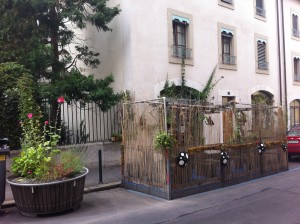
The social and urban history of the Grottes area in the twentieth-century can be told as a long “resistance to modernisation.” From the 1930s onwards, there was a resistance to architectural, infrastructural, functional and aesthetic renewal. However, modernisation was considered easily applicable to this neighbourhood, located so ideally in the centre of Geneva and in the immediate vicinity of the railway station.
The fact that a prominent percentage of the area was owned by the state – a dream for urban planning theorists of the twentieth-century – should have guaranteed the realisation of buildings or infrastructural projects. Yet, decade after decade, the Grottes have resisted firmly, merely allowing ‘light renovations’ and establishing a built and social landscape, which seems to be in total opposition with its central geographic location.
Does this resistance, this progressive installation of a “central marginality” (both assumed and endured) now constitute a true destiny for the Grottes? Will the future of the Grottes result in an alternative project (social, cultural, constructed) or, at the contrary, will the area remain utopic, progressively self-generated along the various forms taken by the resistance?
How does this resistance express itself, architecturally, urbanistically, aesthetically, socially, politically and behaviourally? Which tensions did it foster within the larger structure of the city? Which solutions remain?
Does this resistance, this progressive installation of a “central marginality” now constitute a true destiny for the Grottes?
These questions are at the core of the current project of research and publications initiated by the BAF and developed by academic researchers who are also locals. Deeply concerned with the problem of urban and regional development of their city, such as housing shortage or the exponential rise of commuting traffic, they ask themselves the following question: how will the destiny of the ‘village’ of the Grottes play out in the future?
Fondation Braillard Architectes
16, rue Saint-Léger
CH — 1205 Genève
Tel: +41 22 311 17 17
info@braillard.ch


