Recherche
Publication
June 2012
Polymorphism and polysemy of the gated communities
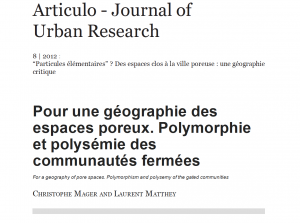
Gated communities are urban forms that tend to generate irritation. From the quest of a secured togetherness to the tendency of secession chosen by the elite (Le Goix 2001, 2006), from the desire of a personal space to the privatisation of privileged spaces (Smithsimon, 2010), from the prospect of a fragmented city to the nightmare of the worst possible world (Fullilove, 2005), the diffusion of residential enclaves, private and closed, frequently assumes the semblance of a dark presence glooming over the future of cities and their capacity to produce society (Low 2003, Charmes 2005). Re-established in a larger epistemological context – the ideal and typical context of the relations between communal space, public space and private space within the urban space in general –, the emergence and the diffusion of this urban form would then signify the appearance of a third city (Matthey 2008) [read].
Fondation Braillard Architectes
16, rue Saint-Léger
CH — 1205 Genève
Tel: +41 22 311 17 17
info@braillard.ch


