Rôle Public
Round table
Tuesday, June 16, 2009
Towards a new governance model?
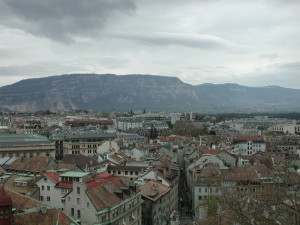
Despite the efforts made by politicians, notably with the introduction of the agglomeration project, numerous urban projects are still on hold. During the press conference that took place on the 4th of February 2008, Robert Cramer has announced the implementation of 14 PLQs and four modified zones as of 2007, which correspond to 2’270 prospective accommodations. At the same time however, several appeals (mostly lodged by residents and only very few by environmental associations) affect or have affected 1’045 potential accommodations.
In Geneva, the causes of urban blocking are well-known and have been identified, for instance in Lendemains d’échecs (Ola Söderström, Fondation Braillard Architectes). In the early 2000s already, the authors of this leaflet have shown how the residents of Geneva refused the project of the Place des Nations (international pole) and that of the Place Neuve (underground car park). Above all other things, the authors denounced Geneva’s incapacity of constructing the common good, because of a lack of integration between parties and also because of a lack of both concertation and participation. Such an analysis is still very much pertinent nowadays.
A considerable challenge adds up to this: from now to 2030, Geneva is expecting more than 200’000 new residents (from 800’000 to a million), 100’000 of which in the city itself – as a corollary of this, mobility demand will rise of 40%.
A conference to judge where we are at. To find ways of escaping urban blocking. For in Geneva, the implementation of principles of durability (poly-centric city, selective densification…) crash into diverging economical, social and environmental interests. Hence the need for arbitration, through a new model of territorial governance; with the passage from a hierarchical model to an open and negotiated one (Michel Callon).
The debate will consider this power play with the help of three case studies: MICA (a first attempt at building an eco-district, following a governance model based on a private-public partnership), PAV (to build the city upon the city with public spaces as structural foundations), PACA Bernex (large-scale governance, following the principles of the poly-centric city and of selective densification of built zones).
Speakers
Nicole Surchat-Vial, urban architect SIA, DT Canton de Genève, in charge of the agglomeration project.
Léonard Verest, urban architect, DT Canton de Genève (MICA).
Carl Fingerhuth, architect SIA, expert (PACA Bernex, PAV, MICA).
Marcellin Barthassat, urban architect SIA FAS (ar-ter), expert MICA and PACA Bernex.
Yannos Ioannides, architect SIA (Comptoir Genevois Immobilier), promotor MICA.
Françoise Chappaz (WWF).
In pictures
Introduction
Bruno Vayssière : PACA et MICA, two models of governance [click here]
Presentation of two case studies
Léonard Verest : MICA project (historic summary and coordination of its players) [click here]
Bruno Vayssière : The keys to success [click here]
Nicole Surchat-Vial : Agglomeration project – PACA [click here]
Yannos Ioannides : Private player in the project – MICA [click here]
Debate
Bruno Vayssière : Geneva, the issue with lawyers [click here]
Marcellin Barthassat : Who manages the project? [click here]
Yannos Ioannides : We need to learn… [click here]
Carl Fingerhuth : Participation or how to develop a context of trust [click here]
Nicole Surchat-Vial : The process is as important as the project [click here]
Françoise Chappaz : WWF not interpellated – issues with means of transportation [click here]
Bruno Vayssière, Yannos Ioannides : MICA and public transportation [click here]
Nicole Surchat-Vial : Mobility concept and agglomeration project [click here]
Léonard Verest : MICA and Mobility [click here]
Françoise Chappaz, Yannos Ioannides : MICA and Mobility [click here]
Michèle Tranda Pittion : The stakes of acting out… [click here]
Marcellin Barthassat : Mobility, to take on habits [click here]
Françoise Chappaz : Mobility [click here]
Public debate [click here]
All the videos
Fondation Braillard Architectes
16, rue Saint-Léger
CH — 1205 Genève
Tel: +41 22 311 17 17
info@braillard.ch


